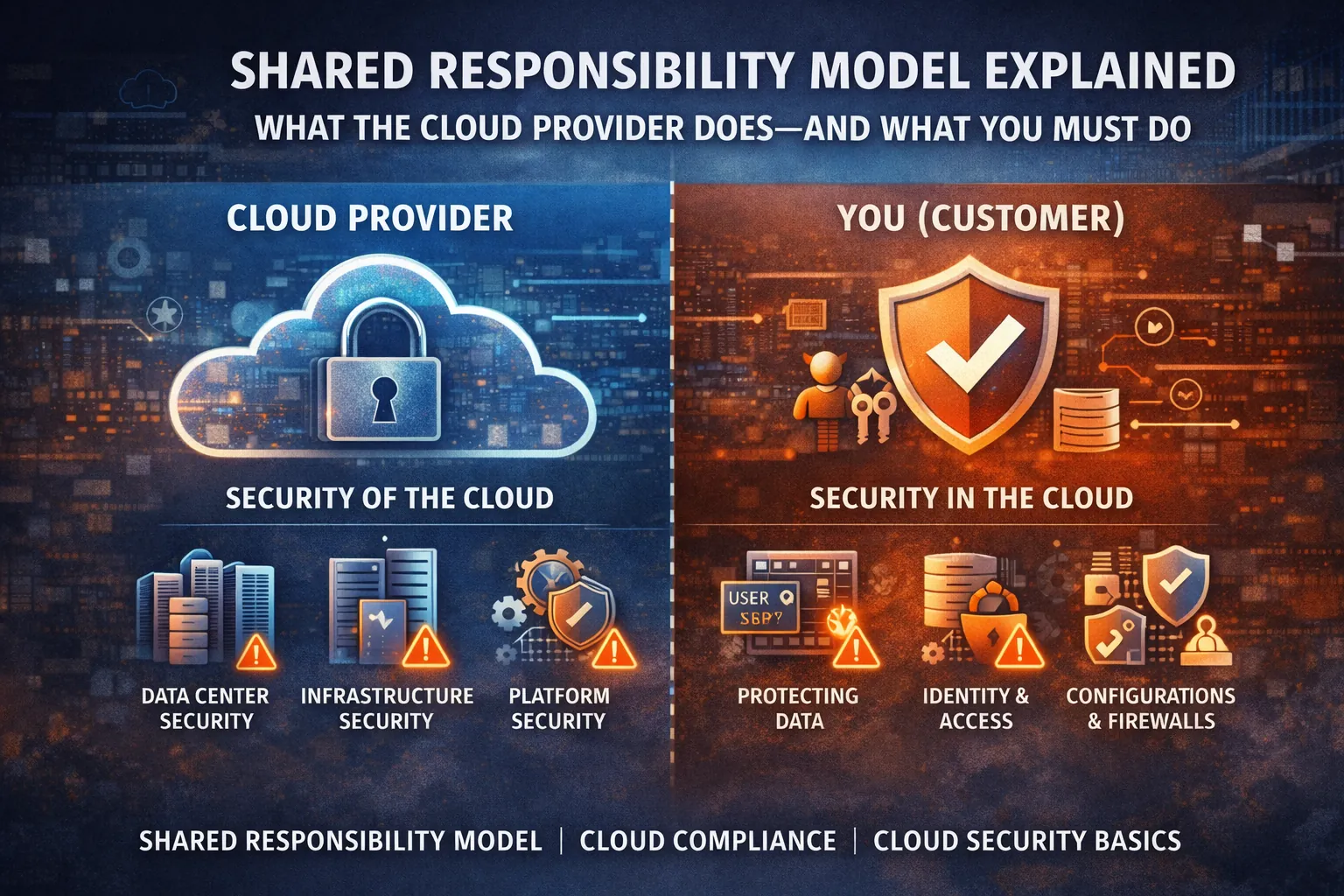
Shared Responsibility Model Explained: What the Cloud Provider Does—and What You Must Do
A clear understanding of the shared responsibility model is critical for securing cloud environments. Many organizations mistakenly assume that moving to the cloud transfers all security responsibilities to the provider. This assumption often leads to serious security gaps.
Under the shared responsibility model, cloud providers are responsible for the security “of” the cloud. This includes physical data centers, hardware, networking infrastructure, and the foundational platform services. These areas are handled at a scale and level of expertise that most organizations cannot achieve on their own.
Customers, however, are responsible for security “in” the cloud. This includes protecting data, managing identities and access, configuring network security, securing applications, and ensuring compliance. The exact responsibilities vary depending on whether the service is Infrastructure-as-a-Service, Platform-as-a-Service, or Software-as-a-Service.
For example, in a virtual machine setup, the customer is responsible for operating system patching, endpoint protection, and firewall rules. In managed database services, the provider handles patching, but the customer still controls access, data classification, and encryption settings.
Failure to understand these boundaries often leads to assumptions such as “the cloud provider will handle backups” or “security monitoring is enabled by default.” In most cases, these features must be explicitly configured and maintained by the customer.
Organizations should document responsibilities clearly and ensure that teams understand their roles. Security architecture reviews, responsibility matrices, and cloud security training help eliminate ambiguity.
When implemented correctly, the shared responsibility model is a strength rather than a weakness. It allows organizations to focus on securing what they control while benefiting from the provider’s robust infrastructure security. Clarity, not assumptions, is the key to making the cloud secure.